Artists of the Possible
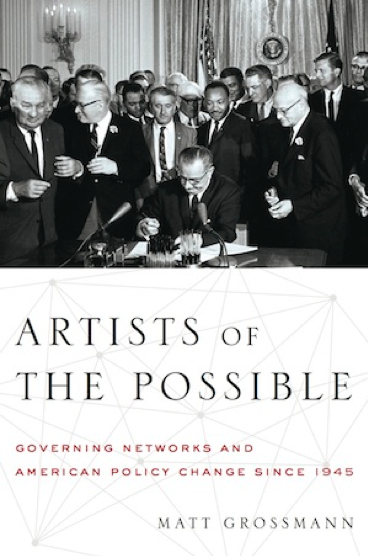
Artists of the Possible: Governing Networks and American Policy Change Since 1945 is now shipping. The book can also be ordered directly from Oxford University Press. The book is part of the Studies in Postwar American Political Development series. More information on the Policymaking History Project and relevant data and articles are available here.
Artists of the Possible has been named an “Outstanding Academic Title” by Choice, a magazine of the American Library Association.
Media
Overview
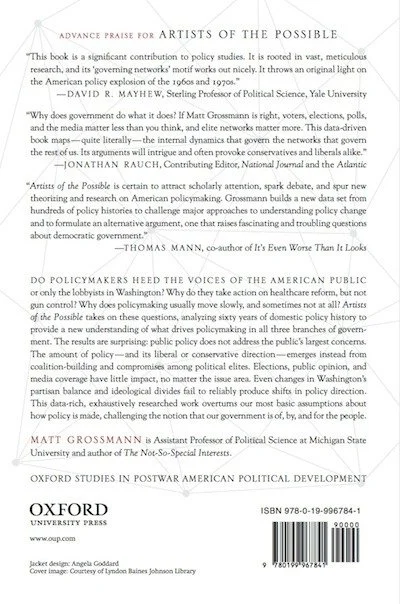
Do policymakers heed the voices of the American public or only the lobbyists in Washington? Why do they take action on health reform, but not gun control? Why does policymaking usually move slowly, and sometimes not at all? Artists of the Possible takes on these questions, analyzing sixty years of domestic policy history to provide a new understanding of what drives policymaking in all three branches of government. The results are surprising: public policy does not address the public’s largest concerns. The amount of policy—and its liberal or conservative direction—emerges instead from coalition building and compromises among political elites. Elections, public opinion, and media coverage have little impact, no matter the issue area. Even changes in Washington’s partisan balance and ideological divides fail to reliably produce shifts in policy direction. This data-rich, exhaustively researched work overturns our most basic assumptions about how policy is made, challenging the notion that our government is of, by, and for the people.
Summarizes the findings from 268 books and reports on American policy history, and broadly covers American domestic policy history since 1945, including 14 different major issue areas-nearly everything that has been a topic of national concern over 60 years
Challenges the most common and basic theories of politics
Integrates theories from popular political history and presidential biographies, studies of policymaking surrounding particular issue areas, and traditional political science research
Reviews
“This book is a significant contribution to policy studies. It is rooted in vast, meticulous research, and its ‘governing networks’ motif works out nicely. It throws an original light on the American policy explosion of the 1960s and 1970s.”
—David R. Mayhew, Sterling Professor of Political Science, Yale University
“Why does government do what it does? If Matt Grossmann is right, voters, elections, polls, and the media matter less than you think, and elite networks matter more. This data-driven book maps—quite literally—the internal dynamics that govern the networks that govern the rest of us. Its arguments will intrigue and often provoke conservatives and liberals alike.”
—Jonathan Rauch, Contributing Editor, National Journal and the Atlantic
“Artists of the Possible is certain to attract scholarly attention, spark debate, and spur new theorizing and research on American policymaking. Grossmann builds a new data set from hundreds of policy histories to challenge major approaches to understanding policy change and to formulate an alternative argument, one that raises fascinating and troubling questions about democratic government.”
—Thomas Mann, co-author of It’s Even Worse Than It Looks
“Matt Grossmann’s insightful and convincing new book… [is] an excellent choice to assign in any upper-level or graduate course on public policy… In addition to the incredible amount of data collection it represents, the author’s careful and convincing rebuttal of existing theories using a variety of methodologies, and his use of network analysis to identify governing networks, is impressive and persuasive. The writing is also very strong, making it an enjoyable read (not to mention a good book to assign to students)… Artists of the Possible is a major achievement… an absolute must-read for anyone interested in public policy - or, for that matter, American politics.”
- Matthew Green in The Forum.
This theoretically and empirically rich book… asks, where does policy change come from?… Elections, the media, and public opinion are not major drivers of policy change. Usually, policy change in any given policy area is primarily the result of negotiation, compromise, and cooperation among elites, especially long-serving legislators, the president, and interest group lobbyists. While offering an explanation of why there has been policy making in some areas but not others, the analysis raises troubling questions about the nature of American democracy and the role of the public within it. Summing Up: Highly recommended.
- Anthony J. Nownes, University of Tennessee, in Choice
“Artists of the Possible raises the bar for studies of the politics of policymaking–American or otherwise…The book also sets Grossmann apart as both social theorist and contributor to the field. It forces us to consider often overlooked, yet pivotal, features of the political process… Grossmann’s theoretical innovation is matched, if not exceeded, by the book’s empirical accomplishment… What emerges from this Herculean effort is a rich portrait of American policymaking that pays careful attention to the actors, issues, and events that lead to major reform.”
- Philip Rocco, University of California, Berkeley, in Public Administration
“Matt Grossman offers a compelling and holistic analysis of American federal domestic policymaking since 1945…The strength of the argument is bested perhaps only by his comprehensive collection of data and meticulous empirical analysis…His contribution is twofold, offering original insights as well as data that will be of use to scholars for years to come…The work is an undoubtedly invaluable contribution to the literature on policy change, even if the findings are at odds with our hopes for democracy.”
- Dino Christenson, Boston University, in Political Science Quarterly
“Matt Grossmann’s new book provides a systematic contribution to our understanding of the dynamics of policy change… The strength of the author’s use of policy histories is the breadth and depth of analysis of important episodes of policy change that have not heretofore been synthesized… we must applaud Grossmann for moving the study of policy formation forward through a novel database and for the questions and puzzles raised”
- Paul Posner, George Mason University, in Perspectives on Politics
“[Grossmann] provides insightful criticism of the existing scholarship, proposes his own theory of policy change, and systematically analyzes the existing policy history literature using network analysis…I commend Grossman for writing a stimulating study by employing innovative methods to critique the literature, posit a theory of policy-making, and suggest real limitations exist for those attempting to build theory.”
- Jeremy Johnson in The Forum.
Table of Contents
Introduction
Chapter 1: The Insularity of American Policymaking
Chapter 2: Aggregating Policy History
Chapter 3: Does the Issue Agenda Matter?
Chapter 4: The Long Great Society
Chapter 5: Issue Politics and the Policy Process
Chapter 6: Explaining Policy Change
Conclusion