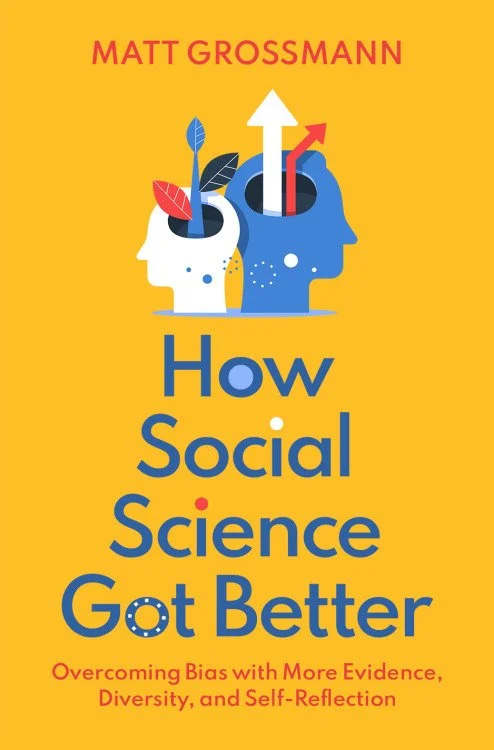
How Social Science Got Better
Media


Overview
Sensational headlines paint a damning picture of the social sciences. Canonical studies do not stand up to scrutiny. Questionable research practices undermine credibility. And clueless academics are caught off guard by real-world recessions and elections that their abstract models failed to predict.
But social researchers are making a lot more progress than it seems.
In How Social Science Got Better, political scientist Matt Grossmann provides a robust defense of the social sciences and an optimistic read on their future. With more evidence, diversity, and self-reflection, social scientists are improving our understanding of humanity and preparing us to confront our collective challenges.
Applying lessons from the philosophy and history of science along with new data on research trends, Grossmann finds that, far from crisis, the social sciences are undergoing an unparalleled renaissance. From economics to sociology, researchers have never been more relevant or rigorous. Burgeoning data and improved methods are uncovering prior blind spots in disciplines as diverse as anthropology and psychology. Scholars are improving by confronting racial, gender, geographic, temporal, disciplinary, methodological, and political biases in their research programs.
Grossmann’s wide-ranging account will force the academy’s internal and external critics to rethink their complaints—from identity politics to ivory tower irrelevance—and instead acknowledge the path-breaking advances occurring across the social sciences today.
Reviews
“Only a few decades ago, social scientists merely studied the problems of human society. Today we contribute to their solution—finding their causes; developing new methods, theories, and datasets; proposing and evaluating public policies; and building a science of human behavior. A change this monumental deserves this important book with Matt Grossmann as our expert tour director. Don’t miss it.” Gary King, Harvard University
“Grossmann’s brilliant book provides a nuanced, thoughtful analysis of the improving trajectory of social science resulting from bigger better data, a more diverse and interdisciplinary academy, methodological advances, and greater engagement with the real world. A book of major importance for practicing social scientists, as well as for the rest of the world who try to understand what social scientists do.” Scott Page, University of Michigan
“In this optimistic and self-reflective book, Grossmann reminds us that the social sciences are absolutely fundamental to understanding ourselves, our societies, our politics. He shows how the social sciences have turned their ample analytical powers to improving our techniques, data, and capabilities to improving our understandings. The book makes a strong case that social science has improved and that improvement can continue.” Roger Pielke, Jr., University of Colorado
“As social science has become more popular and public, it has also come under assault on many fronts. Yet in this compelling and provocative book, Matt Grossmann offers an important counter, arguing that the social sciences are stronger and more vibrant than they have ever been due to the increasing diversity of practitioners, growing humility and caution in offering grand claims, and vast expansions of available data and evidence. Most importantly, Grossmann argues that social science has both the incentive for, and multiple means of, correction and regulation that persistently push scholars in the direction of the truth. The book is sure to generate considerable debate and discussion, but its primary thesis is unquestionably hopeful: The social scientists are alright.” Christina Wolbrecht, University of Notre Dame
“How Social Science Got Better is wide-ranging, accessible, fair-minded, and deeply informed—an indispensable guide to trends in the social sciences and how they make the claims they do. Covering topics from the reproducibility crisis to political polarization, it will be invaluable to a wide swath of social scientists who care about making their fields better—and to a broader public asking hard questions about the value of social science today.” Elizabeth Popp Berman, University of Michigan
Table of Contents
Preface
1. Social Science Biases and Collective Knowledge
2. Open Science Reform and Social Science Progress
3. The Quiet Resolution of the Science Wars
4. Me-Search All the Way Down
5. Universities as Settings
6. Opportunities and Constraints of the Disciplines
7. Multiple Levels of Analysis and Time Scales
8. All History and Policy
9. Motivations of a Practical Orientation
10. Popularization and Consilience
11. Reasons for Cautious Optimism