Asymmetric Politics
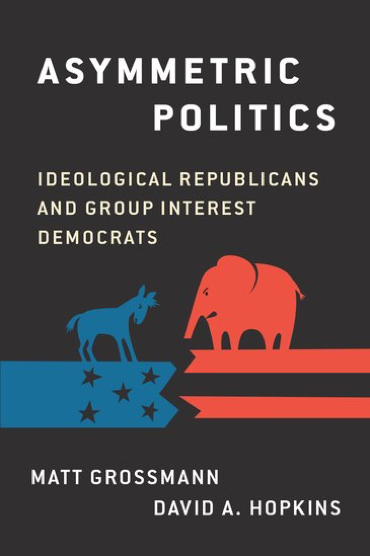
Asymmetric Politics book cover
Media





Overview
Why do Republican politicians promise to rein in government, only to face repeated rebellions from Republican voters and media critics for betraying their principles? Why do Democratic politicians propose an array of different policies to match the diversity of their supporters, only to become mired in stark demographic divisions over issue priorities? In short, why do the two parties act so differently-whether in the electorate, on the campaign trail, or in public office?
Asymmetric Politics offers a comprehensive explanation: The Republican Party is the vehicle of an ideological movement while the Democratic Party is a coalition of social groups. Republican leaders prize conservatism and attract support by pledging loyalty to broad values. Democratic leaders instead seek concrete government action, appealing to voters’ group identities and interests by endorsing specific policies.
This fresh and comprehensive investigation reveals how Democrats and Republicans think differently about politics, rely on distinct sources of information, argue past one another, and pursue divergent goals in government. It provides a rigorous new understanding of contemporary polarization and governing dysfunction while demonstrating how longstanding features of American politics and public policy reflect our asymmetric party system.
Reviews
“The best recent book about how the two parties became what they are” - The Economist
“Not many books change how you think about American politics. This one will. Grossmann and Hopkins’ research decisively shows that the two parties are not the same—and once you understand the ways in which they’re different, American politics begins to make a lot more sense.”—Ezra Klein, Editor-in-Chief, Vox
“This deeply clarifying book not only helps us gain a better grasp of our polarized politics, it also helps to show how the methods of political science can help bridge the gap between the theory and practice of American political life—bringing the former down to earth and lifting the latter toward a more coherent understanding of itself. It is required reading in this confusing time.”—Yuval Levin, editor, National Affairs
“In this detailed and well-argued book, Grossmann and Hopkins present formidable evidence against a still-too-common depiction of American parties, which views their ‘polarization’ as a consequence of their equivalent march away from some imagined middle. Asymmetric Politics encourages a badly-needed re-examination of the very distinctive internal workings and strategic choices of Democrats and Republicans.”—Paul Pierson, John Gross Professor of Political Science, University of California at Berkeley, and co-author of Winner-Take-All Politics.
“The book has marshaled an impressive array of data to examine the parties at every level… Perhaps most persuasively, the book provides a coherent narrative framework to make sense of what otherwise appears to be a great deal of recent political turmoil, driven by the growing demographic diversity of the Democratic coalition on one side and the growing insularity of the Republicans on the other.” - Paul Rosenberg, Salon
“a very important new book… I gave a lot of talks and did a lot of interviews during this election and your book often came to mind. I think it’s a powerful account of where Donald Trump came from, even if that’s not the point of the book. But it makes much more sense in context after having read it.” - Julian Zelizer, PrincetonUniversity.
Included on Best New Books in Political Science, 2016 list by New Books Network. and Election 2016 Recommended Readings from MPSA. “A very extensive deep dive into the differences between Democrats and Republicans… it sketches [them] out in fascinating detail with a lot of supporting evidence.” Lilly Goren, Carroll University.
“Grossmann and Hopkins help us make sense of some of the perennial frustrations of American politics…If only Democrats and Republicans understood that their respective motivations are different, they might be able to recognize the best, instead of the worst, in each other.” Nick Ottens, Atlantic Sentinel
“Grossmann and Hopkins provide a fresh and incisive analysis of the state of America’s party politics. Analyzing evidence including campaign speeches, party platforms, public opinion surveys, and Congressional voting patterns, they argue that the contemporary GOP has become a vehicle for an ideological movement, while Democrats aim at distributing benefits to groups in their partisan coalition.” - Steven Schier, Choice
“It sums up, with a massive array of research findings, much of what we know now about the officeholders, structures, and voters of the Republican and Democratic Parties. It is an outstanding book that deserves to be widely discussed by colleagues… an outstanding piece of political science research, synthesis, and analysis, whose authors lay out findings about the differing virtues and shortcomings of both parties.” - David Ricci, Perspectives on Politics
“Grossman and Hopkins demonstrate empirically just how incomparable the parties are. They are chalk and cheese. Republican voters are much less likely than Democrats to relate to specific issues or see themselves as part of an interest group. They are much less interested in specific government benefits or legislation targeted at particular social problems. Their worldview is much more abstract.” - Peter Murphy, Quadrant
Table of Contents
Introduction: Two Different Kinds of Parties
How Democrats and Republicans Think About Politics
An Ideological Movement Versus a Social Group Coalition
The Not-So-Great Debate
Campaigning in Poetry and Prose
Policymaking in Red and Blue
Conclusion: American Politics Out of Balance
Media
Our op-eds in the New York Times:
The Monkey Cage from The Washington Post:
Republicans and Democrats can’t even agree about how they disagree
How different are the Democratic and Republican parties? Too different to compare.
How the conservative media is taking over the Republican Party
Vox.com Polyarchy:
The mess of health reform: trying to achieve Democratic goals through Republican means
Why primary elections scare Republican politicians more than Democrats
Our op-ed in the Detroit Free Press:
Our op-ed in Inside Higher Ed:
Interviews on the book:
The project has also stimulated media interest:
“The Summer of Sanders and Trump” by Clarence Page, Chicago Tribune and syndicated.
“They’ll always move further right: Why every defeat only makes Republicans more extreme” (with long-form interview), “Why We Need a Return to Moral Politics”, “Overcoming the Democrats’ Civil War,” “Understanding the GOP’s health care failure,” “How Do We Combat Alternative Reality?” “They’re Still Not Telling the Real Story“ “Beyond Trump’s threat,“The Challenge to Issa,“ “America is Ready for Socialism,” and “Stronger than Tea” by Paul Rosenberg at Salon
“How are Republicans and Democrats Different?” ”Why are We So Divided?,“ “Putting the Democratic Party on the Couch” and “Identity Politics: Up from the GRAVE” by John Goodman at Townhall.
“What the Clinton and Sanders Progressive Debate Really Shows” “Why Most Voters Stick with Clinton and Trump No Matter What” and “Trump says GOP is now Party of the Working Class: Is he Right?” by Peter Grier at Christian Science Monitor
“Trump and the Madness of Crowds” by Ross Douthat at the New York Times. Dave responds here: “What Does Trump Tell Us About the Republican Party?”
“Why Trump Hiring Breitbart Head Should Come As No Surprise,” Sam Roudman, Vocativ
”Bobby Jindal: One Wonk to Rule Them All?“ by Seth Mandel in Commentary.
”Did Vox Justify the Tea Party?“ by Pocket Full of Liberty, Vox Chart of the Week
“Why race and identity will remain the dividing line in American politics for a while to come,” Lee Drutman and “Democrats are losing to Republicans at the state level, and badly. Here’s why” by Alexander Hertel-Fernandez and Theda Skocpol
”Are Progressives Too Pragmatic to Vote for Progressives?“ on Slate Gabfest
”The Political Divide: Obama’s Final SOTU“ by Mormon Iconoclast
”The Great Ideological Divide“ by Paul Jacob
”The GOP’s Anti-Obamcare Dogma“ by Andrew Sullivan in The Dish.
”Why Americans Think They Are Opposed To Gun Control, But Really Aren’t“ by Ian Millhiser at ThinkProgress.
“Don’t Expect a Realignment of American Politics” by Nolan Watts, Rise News
”Are Republicans the Party of the Status Quo?“ from the Niskanen Center.
“Anti-Establishment Sentiment Wrecked American Politics,” “Americans’ Hardening Attitudes, Party Asymmetry Root of Gridlock,” “Realignment Less Likely than Republican Split,” “Debate Shows Why Clinton is the Proper Democrat,” “Democrats Are Now the Party of Real America,” and “Not Just the Lesser of Two Evils: The Case for Clinton” in Atlantic Sentinel.
”Tech nerds are smart. But they can’t seem to get their heads around politics“ and “Donald Trump and the Rise of Tribal Epistemology” by David Roberts, Vox.
“The dangerous politics of hard promises” by Mark Schmitt at Vox Polyarchy and “Ideological mobilization helps parties, unless it overpowers them” by Jonathan Ladd at Vox Mischiefs of Faction.
“The right’s Trump phenomenon: Why the left won’t spawn a policy-free demagogue any time soon” and “Why turnout matters, even in true-blue districts” by Sean McElwee at Salon.
”Framing and party competition: How Democrats enabled the GOP’s move to the uncompromising right,“ Robert M. Entman, Brookings Report.
“The Confusing, Anticlimactic Demise of Ben Carson,” Kelefa Sanneh, New Yorker
”Ohio Republicans give voters a chance to reform legislative redistricting, but buyer beware“ by Steven Wolf, Daily Kos. “The Cult Called the Republican Party,” Libby Shaw, Daily Kos
“Republicans and Democrats, two parties, two worlds,“ Roger Senserrich (spanish language)
”Michigan pollster has good news, bad news for both parties,“ Jack Lessenberry, Toledo Blade
“Why a Democratic Trump Can’t Happen,” Jerold Duquette, WGBH
“Perfect Pundit for the Trump Generation,” The Ringer.
”The Hyper-Polarization of America,“ Alex Theodoridis, Scientific American.
Comments from: Duke Political Review, the Democratic Strategist, More Soft Money Hard Law, Minds and Discourse.
The Great White Mope, California Magazine; BC Gavel coverage
“Can the Democratic Party be White Working Class, Too?” by Justin Gest.
An interview with Matt Townsend on BYU radio.
Julia Azari in a FiveThirtyEight liveblog, Washington Monthly posts, and a Vox post. “The Two Cracks in the Republican Party” by Julia and Harry Enten.
”The Democratic Party Sucks Hard, A Scholarly Analysis,“ OrgTheory.
”Working Class Republicanism,“ Kyle Kondik, Sabato’s Crystal Ball
”Most Republicans Think Colleges are Bad for the Country. Why?,“ Clara Turnage, Chronicle of Higher Education
”Three Perspectives on Fake News,“ Platypus.
”Should We Want the Center to Hold?“ Matthew Sitman, Commonweal.
”Some of the GOP’s Institutions Have More Reason to be Loyal to Trump than Others,“ Perry Bacon, Jr. at FiveThirtyEight.
”Flat Earthers and Feedback Loops,“ Todd Gitlin, HuffPost.
”Will Congress Listen to the Kochs or the Docs on Health Care?“ Phil Rocco, Madison.com
”The Democrats’ Foolish Family Feud,“ David Faris, The Week.
”Trump’s Populism Was a Ruse,“ E.J. Dionne, Washington Post.
This tweet from Nate Silver of FiveThirtyEight.
Chuck Todd Interview on Unscripted, POTUS Siriux XM
Related Research and Resources
See the proposal here: “Asymmetric Politics“ An article from the project was published in Perspectives on Politics: Ideological Republicans and Group Interest Democrats: The Asymmetry of American Party Politics (ungated). Our earlier papers in the project address “Party Asymmetry in American Election Campaigns,” “Unequal Demands: Policy, Polarization, and Party Asymmetry in American Politics,” “Party Asymmetry in the News Media,” “The Ideological Right vs. The Interest Group Left“ from MPSA 2014 and ”Policymaking in Red and Blue: Asymmetric Partisan Politics and American Governance“ from APSA 2014.
For further related reading, see my book Artists of the Possible: Governing Networks and American Policy Change Since 1945, my op-ed ”The Liberal Arc of U.S. Policy,“ my co-authored article ”Party Coalitions and Interest Group Networks,“ and this forthcoming article by Yphtach Lelkes and Paul Sniderman.
We also wrote a blog post on the project at The Monkey Cage: “More proof that Republicans are from Mars and Democrats are from Venus.” The project stimulated a critique from Hans Noel; we respond here: “Group-Centered Democrats Are Not Secret Ideologues, and Conservatism Is More Than Disguised Group Interest.” Dave is also blogging about our project: “Why the “Trump’s Not a Conservative” Gambit Is Getting Another Try,” “Bernie Sanders and the Search for a Liberal Party,” “Clinton Bets on the Democratic Coalition,” “Most Democrats Aren’t Liberals…Or “Progressives,” and “What Does Trump Tell Us About Partisan Media Asymmetry?”
Thanks to The William and Flora Hewlett Foundation for supporting our related project: “Asymmetric Parties in American Policy Debates.” Here is the grant proposal. Here is our codebook and reliability analysis. Our original datasets are now available for public use. This new working paper uses our dataset: “Talking Past One Another: Trends in Republican and Democratic Elite Rhetoric” Dave wrote a paper applying the theory to the 2016 nomination contest.